Protecting Children from Radiation Exposure Produced by the SAY-Peace Project Editorial Supervision by Dr. Matsui Eisuke, Gifu Environmental Medicine Research Institute Translation by John Junkerman Introduction: Our Basic Stance The accident at the Fukushima Daiichi nuclear power plant that occurred after the Great East Japan Earthquake on March 11 has released large amounts of highly radioactive material into the air, sea, and soil, and it continues to affect our lives. Young children are particularly susceptible to the effects of radiation. In order to protect children from exposure to radiation, pregnant women and parents of small children are required to exercise caution in their daily lives and to act on the basis of accurate information.
The government has made announcements such as “There is no immediate danger to health” and “We have established safe standards.” But there has been little effort to explain the mechanisms of radiation exposure (in particular, the internal exposure from breathing, eating, or drinking contaminated matter), and no attention has been paid to the danger of delayed effects that may appear in 10 or 20 years.
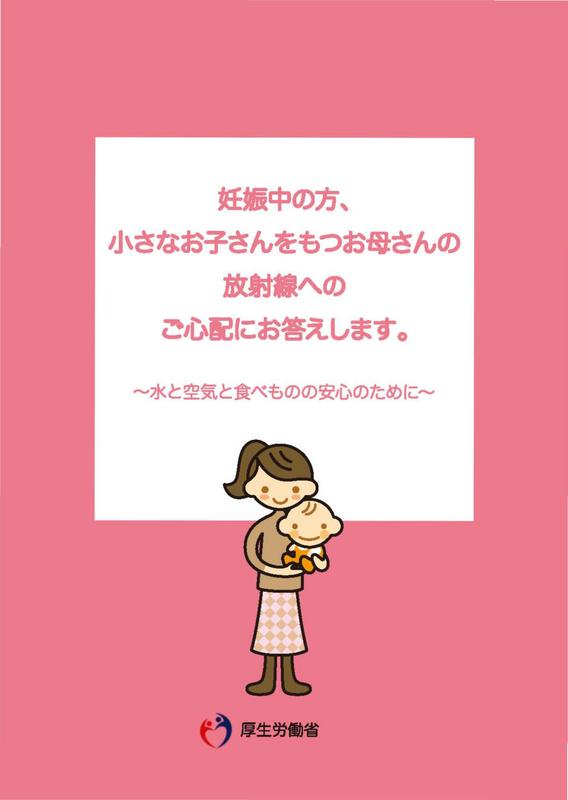
Many specialists in radiation medicine have pointed out that the standards for exposure that the government has set cannot be considered “absolutely safe.” Nonetheless, a pamphlet published on April 1 by the Ministry of Health, Labor, and Welfare assured pregnant women and the mothers of small children that “there is no need to worry,” without providing any scientific basis for the claim. This is the height of irresponsibility. (The photo at the right is the cover of the pamphlet.)
There are still many things we do not know about the physical effects of radiation, but this lack of understanding should not lead us to relax. Rather, it is important to maintain this stance: since we do not know, we should exercise the utmost caution, and avoid exposure to radiation to the furthest extent possible.
We hope this pamphlet will be of use in protecting children from exposure to radiation.
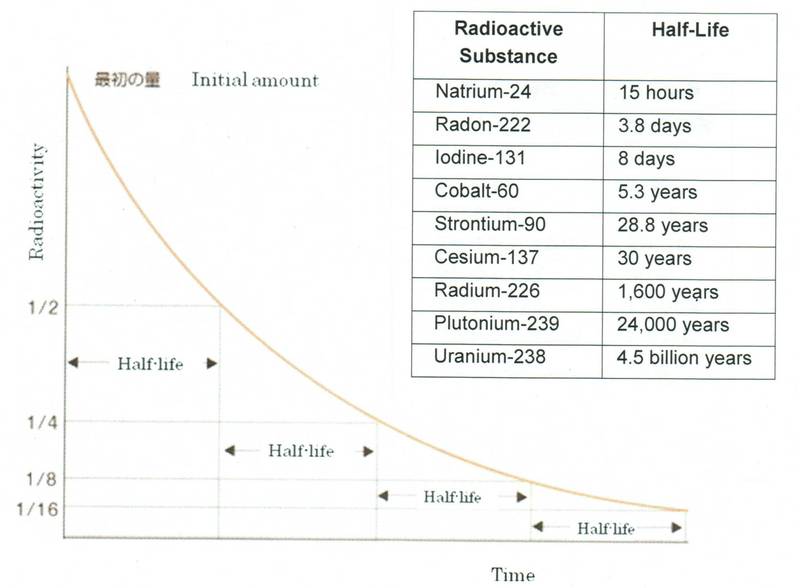
What is Radioactivity? “Radioactivity” is the ability to emit radiation, and substances with that ability are called “radioactive substances.” Radiation takes the form of rays that are able to pass through matter. Through a process called “ionization,” they can damage the cells and DNA that make up the human body, resulting in a variety of physical effects. One of the insidious features of radiation is that it cannot be seen or smelled; it is not perceptible to normal human senses. “Half-life” refers to the time it takes for a radioactive substance to lose half of its original strength. For example, the half-life of iodine-131 is eight days, while cesium-137 has a half-life of 30 years. It is often said that radioactivity dissipates over time, but it is important to remember that a substance retains half of its radioactive strength after its half-life has passed; after another half-life, it still retains one quarter of its original strength, and so on. We must also remember that until the Fukushima accident is fully under control, the reactors will continue to discharge radioactive substances into the environment.
What are the Effects of Radiation on the Human Body? When the physical effects of radiation are discussed, it is common to hear the term “threshold.” The threshold is the standard value or permissible amount for the risk from exposure to radiation, and it is often said that being exposed to radiation below threshold levels has no effect on the human body.
However, it is not possible to assert that exposure below the threshold is “safe” or that it “has no effect on one’s health.” No matter how weak radiation is, it causes damage to human cells. Therefore, there is no such thing as a “safe level.” The more you are exposed to radiation, the greater the danger of damaging one’s health.
|
In fact, a committee of the National Academies of Science in the US issued a report in 2005 that concluded that there is no threshold: the risk of exposure exists in direct proportion to the amount of exposure, beginning at low levels. Minimal exposure represents a potential danger to humans. Even the International Commission on Radiological Protection (ICRP), which uses measurement techniques that underestimate internal exposure and low-level radiation exposure, supports this “linear no-threshold model” and acknowledges that doses of radiation under the threshold of 100 millisieverts annually still increase the risk of developing cancer. In other words, it is now accepted wisdom internationally that, even at low levels, radiation affects the human body.
As a consequence, the proper approach when thinking about radiation is not to say, “It’s OK to be exposed to this amount,” but rather, “We should exercise the utmost caution, and avoid exposure to radiation to the furthest extent possible.”
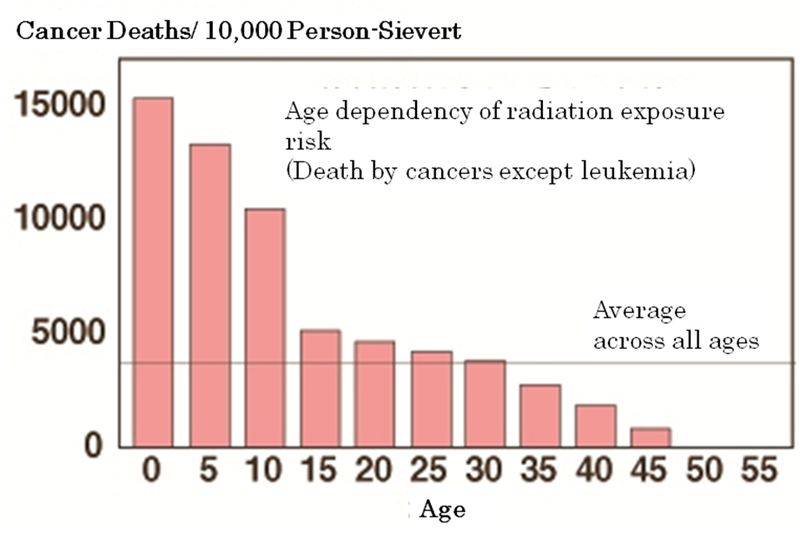
What are the Effects on Fetuses and Babies? Fetuses, babies, and young children are far more susceptible to the effects of radiation than adults. It has been estimated that babies and infants are four times as vulnerable as adults in their 20s or 30s, so the risk of exposure is much greater. This is because cell division takes place much more vigorously in small children, so cells that are damaged by radiation are reproduced before they can be repaired.
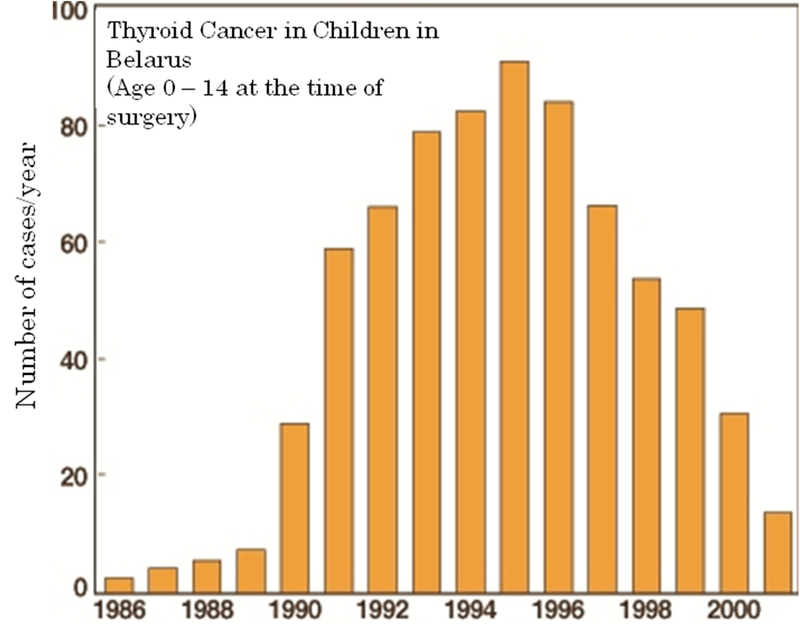
In Belarus, where the effects of the Chernobyl nuclear accident were most severe, the rate of thyroid cancer among children increased rapidly 5 to 10 years after the accident. One should not be reassured when the government announces that “there is no immediate health risk.”
Based on a lecture in Japan by M. Malko, “Assessment of Chernobyl Cancers in Belarus” (2003).
Why is “Internal Exposure” Dangerous?
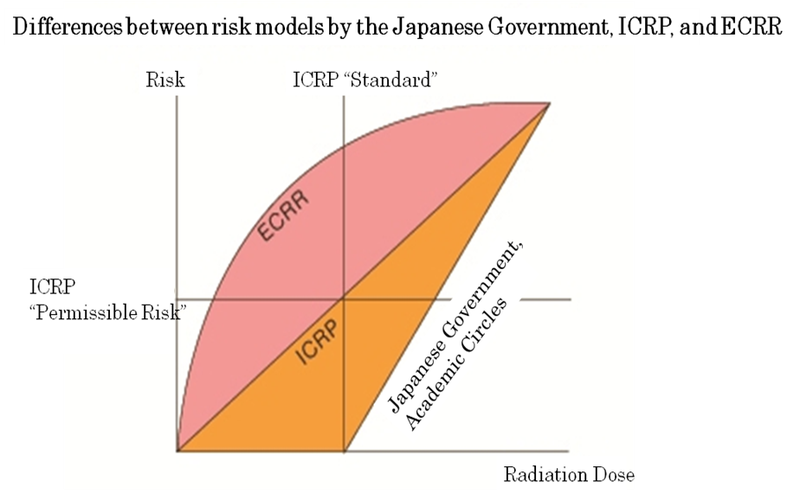
Exposure to radioactive substances outside of the body is referred to as “external exposure.” On the other hand, when tiny particles of radioactive substances are breathed into the lungs, or ingested through mother’s milk or cow’s milk, water or food, the exposure to this radiation is termed “internal exposure.” Internal exposure differs from the short-term external exposure caused by X-rays and CT scans, because the exposure is at a very close distance and it continues over a long period of time. This has led the European Committee on Radiation Risk (ECRR) to conclude that even low levels of radiation pose high risk. |
Pink zone: Risk that the International Commission on Radiological Protection ignores.
Pink + orange zones: Risk that the Japanese governmnent and academic circles ignore.
Simply expressing radiation dose in sieverts is insufficient, as we need to know which nuclides are involved. Risk models are also affected by other variables, such as age, sex, genetic makeup, immunity, and time period, so the standard level is no more than an averaged-out, rough guideline. Matsui Eisuke, “Health Effects on Children of Internal Radiation Exposure,”Gekkan Hodanren, 6, No. 1067 (2011).
Radioactive substances that enter the body accumulate in various organs and continue to emit radiation. The chemical composition of the substances determines how they are absorbed by the body’s organs and how long they remain in the body (biological half-life). Iodine-131 concentrates in the thyroid, where it causes thyroid cancer. Cesium-137 is considered dangerous because it lodges throughout the body, in the bones, liver, kidney, lungs, and muscle tissue. Strontium-90 and plutonium-239 remain in the body for a long time, so once they have entered the body, they continue to affect it over the course of many years.
|
This diagram depicts the inhalation of plutonium, but the process is essentially the same for other radioactive isotopes. Iodine binds to thyroglobulin, the protein that forms the base of the thyroid hormone, so it concentrates in the thyroid and can cause thyroid cancer.
When the air and soil have been contaminated, the contamination first spreads to plants and agricultural products, and then to animals. Through the food chain, the radiation is carried from one animal to the next, until it reaches human beings. In many cases, the radiation becomes more concentrated through this process. Even if the nuclear accident is brought under control and radiation levels fall, highly contaminated food products may continue to enter the market in the future because of this process of biological concentration. It is estimated that iodine in the air becomes concentrated up to ten million times in plants and 620,000 times in milk. Cesium becomes concentrated five times in mollusks, and twenty times in other marine products.
The Contamination Zone
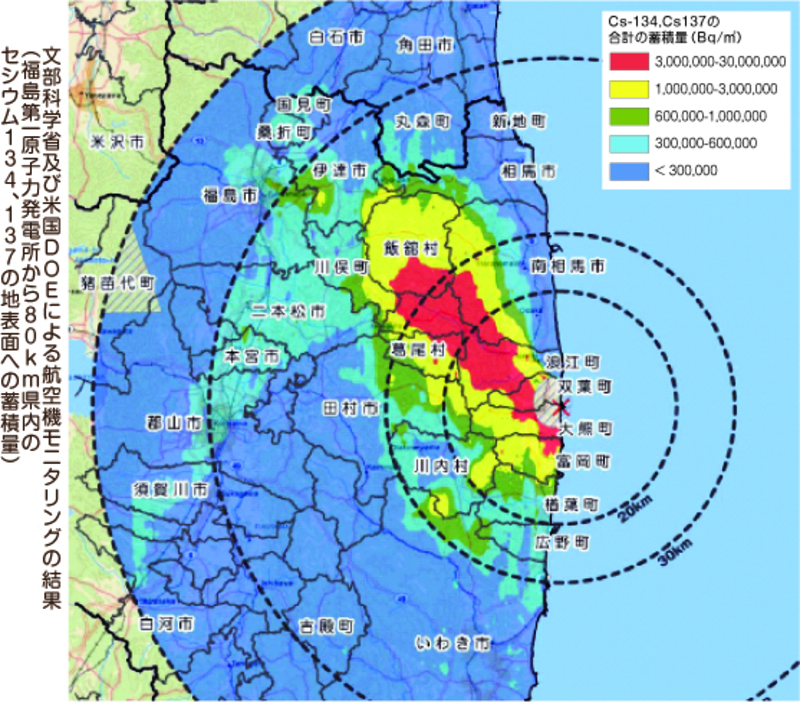
“Hot spots” are areas where rain and snow bring down radioactive substances from the clouds and where high concentrations of these substances are then detected. This applies particularly to the area downwind of a reactor; in the case of the Chernobyl accident, areas 300 kilometers downwind of the plant were contaminated. Because of this dispersal, it is necessary to put into place detailed countermeasures, utilizing the computer system called SPEEDI (System for the Prediction of Environmental Emergency Dose Information). Recently discovered “hot spots” are in the cities of Fukushima, Koriyama, Nihonmatsu, Date, and Iwaki.
The result of MEXT (Japanese Ministry of Education, Culture, Sports, Science and Technology) and the US Department of Energy’s aerial monitoring (accumulation of cesium-134 and cesium-137 within the 80 kilometer radius of the Fukushima Daiichi nuclear power plant).
In areas that are considered hot spots, national and regional governments must take measures to evacuate people, particularly pregnant women and young children. Government authorities must take responsibility for providing nursery schools, day care centers, and other schools in areas that are freer from contamination.
In areas outside of these hot spots, it is often suggested that parents need not be overly concerned about allowing their children to play out of doors. However, in Tokyo’s Suginami Ward, for example, the airborne radiation level was 0.13 microsieverts/hour on April 20, but it was as high as 6.39 microsieverts/hour on the surface of the ground. In addition, radiation levels rise during and after rainfall. In such areas, children should avoid getting wet in the rain. Since small children are especially vulnerable to radiation, great care should be taken; they should avoid going outside, and when they do, they should wear a facemask.
Radiation in Tap Water and Breast Milk
The government insists that the water supply is monitored to ensure its safety, but standards in Japan are dramatically higher than in other countries. On March 17, the government raised the standard for iodine-131 from 10 Bq/L (becquerels per liter) to 300, and the standard for cesium-137 from 10 Bq/L to 200. Further, under the Food Sanitation Law, the provisional guideline for liquids given to infants is 100 Bq/L; this level “poses no health risk,” even to infants under 1 year old.
However, standards for iodine-131 elsewhere in the world range from the World Health Organization’s 10 Bq/L to German Technical and Scientific Association for Gas and Water (DVGW)’s 0.5, with the US Environmental Protection Agency (EPA) maintaining a guideline of 0.111. In other words, Japan’s standard is 2,700 times higher than that of the US EPA in the case of iodine-131.
World Standards for Iodine-131 in Tap Water (Bq/L)
| US EPA | DVGW
(Germany) | Ukraine | Belarus | WHO | Japan's Provisional Guideline |
| 0.111 | 0.5 | 2 | 10 | 10 | 300
(200 for cesium-137)
[100 for infants] |
In addition, there is the problem of inadequate monitoring. The Bureau of Waterworks in the Tokyo metropolitan government, for example, publicly announced as “undetected” radiation contamination at levels less than 20 Bq/L until April 14. Until the government tightens safety standards, pregnant women, nursing mothers, and small children should use tap water only for bathing and washing clothes and dishes, in areas surrounding Fukushima Daiichi plant including the Kanto area. Avoid drinking tap water as far as possible, to reduce the risk of internal exposure to radiation.
As for breast milk, we cannot simply generalize that mothers should avoid breastfeeding, considering nutritional (immunity) and safety benefits of breast milk, especially when babies less than three-months old are concerned. According to a survey by the Breast milk Survey and Mother-Child Support Network, there were cases in which no radioactivity was detected in breast milk of mothers living in hot spots, while radioactivity was detected in breast milk of a mother in Mitaka, which is not a hot spot. Therefore, breastfeeding mothers should avoid internal radiation as much as possible, regardless of where they live. Also, increased testing of breast milk must be done in order to take appropriate protection measures.
Radiation in Food
First, since radioactive iodine is still being detected, we must abstain from eating leafy vegetables, herbs, and wild plants from contaminated areas. In particular, vegetables with broad leaves (spinach, lettuce, etc.) carry a high risk because they have large surface areas. The government is prohibiting the shipping of produce with radiation surpassing the standards, but on April 26, for instance, spinach produced in Chiba Prefecture was shipped despite a government ban. Further, the Food Safety Commission has raised the provisional standard for radioactive cesium in vegetables from 370 Bq/kg (previously set by the Ministry of Health, Labor, and Welfare) to 500 Bq/kg.
World Standards for Radiation in Food
| Isotope | Food Group | Ukraine | Belarus | US | Codex Commission | Japan |
| Radioactive Iodine | Baby food, drink | | | 170 | 100 (Total of five nuclides: Sr 90, Ru106, I129, I131, U236) | 100 |
| Milk, milk products | 300 |
| Meat, eggs, fish, etc. | 2000 |
| Radioactive Cesium | Baby food, drink | 40 (food for small children) | 37 | 1200 | 1000 (Total of eight nuclides: S35, Co60, Sr89, Ru103, Cs134, Cs137, Ce144, Ir192) | 200 |
| Milk, milk products | 100 | 100 | 200 |
| Vegetables | 40 (70 for fruits) | 100 (40 for fruits) | 500 |
Citing the uncertainty of the criteria for safety testing and regulation, the German Society for Radiation Protection recommends not giving food or drink that contain more than 4 Bq/kg of cesium-137 to infants, children, or young people.
Again, even if the nuclear accident is brought under control and radiation amounts return to low levels, biological concentration may result in highly contaminated food products still entering the market after the passage of some time. In order to prevent internal exposure to radiation, it is necessary to tighten the safety standards, increase testing for radiation, and thoroughly enforce bans on shipping contaminated produce. Of course, the government and Tokyo Electric Power must compensate farmers and other producers for the losses suffered by bans on the shipping of contaminated produce.
Summary of Protection Measures
Here we summarize the protection measures that have been suggested. It is difficult even for specialists to agree on such measures, and these steps will not necessarily ensure one’s safety. Rather, they are no more than some areas where we can exercise caution in our daily lives. In giving first priority to safety, evacuation measures taken by the national and local governments are an indispensable element of prevention, to protect the lives of children. Evacuation must be seen as a right, with the government bearing the burden of moving expenses and employment measures, rather than something that is the responsibility of the individual.
Below is a list of temporary measures that individuals can take.
Air: This applies particularly to areas that are contaminated hot spots.
- Remain indoors as far as possible. Keep outside air from entering (It is difficult not to use air conditioners, fans, or to keep windows closed in the summer time. Some air conditioners allow very little outside air to come indoors. Please consult with manufacturers).
- When you go outdoors, wear a facemask or cover your mouth and nose with a towel.
- Wear a hat, do not expose skin, and wear a jacket that will not collect dust.
- Before entering the house, with the facemask still on, brush dust off your clothing.
Even outside of hot spots, radiation is highest during and after a rainfall. In areas surrounding the Fukushima Daiichi plant including the Kanto area, avoid getting wet in the rain. Avoid going out. Wear a facemask.
Breastfeeding: We cannot simply generalize that mothers should avoid breastfeeding, considering nutritional (immunity) and safety benefits of breast milk, especially when babies less than three-months old are concerned. Regardless of whether breastfeeding mothers live in hot spots or not, it is necessary to minimize internal radiation exposure and to increase the testing of mother’s milk in order to develop appropriate protection measures.
Tap water: Until the government tightens safety standards, pregnant women, nursing mothers, and small children should use tap water only for bathing and washing clothes and dishes. It should not be used for mixing formula. Avoid drinking tap water as far as possible.
Food: For the time being, abstain from eating leafy vegetables, herbs, and wild plants from contaminated areas. Also avoid milk, meat, and fish, which can be highly contaminated due to bioaccumulation. It is necessary for municipalities and schools to thoroughly disclose where food comes from, and increasing the testing of radioactivity in food is urgently required.
In Conclusion
Since March 11, many people have found it difficult to relax in their normal lives, out of concern for earthquakes and the nuclear accident. At the same time, we are told repeatedly, “There is no need for excessive worry, which is actually bad for your health.” Or, “There is absolutely no problem with food on the market.” Or, “Misinformation and rumors are causing harm.” Some of us may feel that we are the only ones who are worried, or that those around us think that we are being alarmist.
However, it is only natural to be concerned. With radiation, it is not possible to say, “You’ll be fine as long as you limit your exposure to this level.” We do not understand with any certainty the physical effects of radiation. If we assign the highest priority to safety, then exercising utmost caution and adopting the strongest preventive measures is not out of line. It is the obvious thing to do.
But it is also true that there are limits to the preventive measures that individuals can adopt. No matter what you do, if there are radioactive materials present, you will be exposed. The best possible route is to remove oneself as far as possible. Those who can evacuate should do so. It is very dangerous for those people in highly contaminated areas of Fukushima to remain there. Policies and measures for evacuation should be implemented to the furthest extent possible.
It is best not to worry over radiation in isolation. There are many people living close by who share your concerns. It is important to talk with these people, to make connections, and to provide mutual support.
The nuclear accident and the scheduled power outages that followed have caused us to think a great deal about our own lives and the problems of electricity and energy. If we didn’t have nuclear power plants, we wouldn’t have to be concerned like this about the risks of radiation.
Japan is beginning to reconsider its nuclear energy policy. The Hamaoka nuclear power plant in Shizuoka, which is at risk of causing a catastrophic radiation disaster if the predicted Tokai earthquake occurs, has already stopped operation. The time has come to think about how society could function without relying on nuclear energy.
What is the SAY-Peace Project?
SAY-Peace Project is a non-profit organization run by young people in their teens and 20s, who have come together under the slogan "Solidarity among the Asian Youth for Peace." We provide a space for young people to learn about, think, and act for peace. We engage in a variety of activities with the aim of bringing about peace, from Asia, through dialogues about disarmament and history.
Contact information:
SAY-Peace Project
Coop Matsuo #103, Daizawa 5-7-8, Setagaya-ku, Tokyo 157-0032
Tel/Fax 03-4413-3929 E-mail:
mail@saypeace.org Home page:
SayPeace.org.
Dr. Matsui Eisuke, editorial supervisor
Born 1938. Director, Gifu Environmental Medicine Research Institute. Previously taught radiology at Gifu University School of Medicine. Japanese Respiratory Society certified specialist. A special member of the Japan Lung Cancer Society and the Japan Society for Respiratory Endoscopy. One of the few specialists in Japan to address the problem of internal exposure to radiation. Matsui has been involved for many years with class-action suits over the certification of atomic-bomb victims, and has also written extensively on the health effects of asbestos. His latest book is Mienai kyôfu: Hôshasen naibu hibaku (Invisible Terror: Internal Exposure to Radiation) (Junpôsha, 2011).